Inner Planets
Mars
Mars is the fourth planet from the sun. It is named after the Roman god of war. It is called the—red planet because its surface is covered with bright reddish patches caused by iron oxide, a mineral that is found on the surface of Mars. These bright reddish patches are thought of to be deserts.
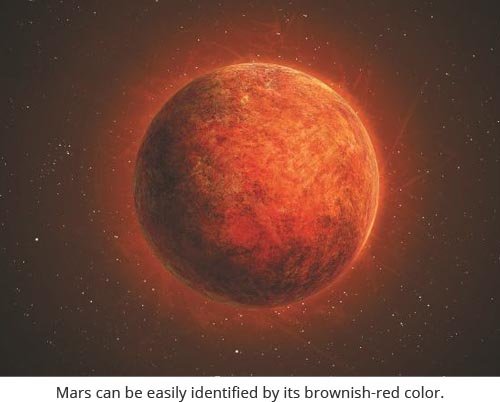
The atmosphere of Mars is thinner than that of Earth. Since the planet does not have a protective layer of atmosphere, it cannot store heat from the sun. The temperature on Mars drops at around –82°C in winter and rises to only about –5°C in summer. Mars has seasons just like Earth. It has ice caps at its poles. Mars has ice caps at its north and south polar regions.
Mars is covered with craters caused by falling rocks that hit the planet. Astronomers have found around 43,000 craters on Mars. The planet also has certain features similar to those on Earth. The highest volcano in Mars is the Olympus Mons, which is approximately 25 km high, and the largest canyon is the Valles Marineris, which extends 3,000 km long.
Mars is around 6,794 km in diameter and about 227.94 million km from the sun. It takes approximately 24 hours and 37 minutes for Mars to rotate on its axis. Hence, the length of a day on Mars is almost the same as that on Earth. On the other hand, Mars completes one revolution around the sun in 686.99 days, almost twice as the period of revolution of Earth. Two small moons, Deimos and Phobos, revolve around Mars.
Like Earth, it has three parts—crust, mantle, and core. Its crust is a thin layer made of rocks. The thick mantle is made of silicates. The small core is made up of iron and nickel. Unlike Earth, its core has no liquid metal and has no magnetic field. There is no liquid water on Mars. Its water is covered with frozen carbon dioxide.
The atmosphere of Mars is composed of carbon dioxide with small amounts of other gases. It has a very cold temperature because of its distance from the sun. It has distinct seasons similar to that of the Earth because of its tilted axis.