Inner Planets
Venus
The planet Venus is the second planet from the sun. It is named after the Roman goddess of love and beauty. Aside from the sun and the moon, Venus is the brightest object in the sky as seen from Earth. Thus, because of its enchanting glow, the planet has been associated with beauty.
Venus is about 12,104 km in diameter and approximately 108 million km away from the sun. Venus is called Earth’s sister planet because it is almost as big as Earth. However, Venus looks bigger than Earth because of the very thick layer of gases that surrounds it.
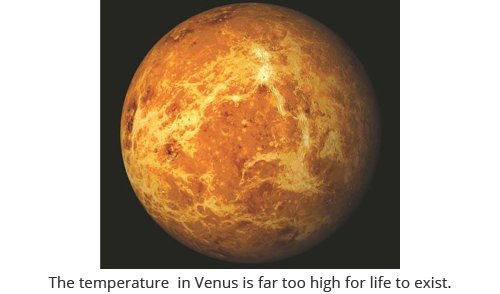
Venus is surrounded by thick clouds, and its surface is mostly bare rock and desert. In 1993, a spacecraft radar revealed that Venus has continents, mountains, and craters.
The atmosphere in Venus is made up of carbon dioxide. The heat from the sun cannot escape through the clouds and layers of carbon dioxide. Thus, the temperature in the planet reaches about 460°C, which is hot enough to melt lead, making Venus the hottest planet. This extreme heat and the composition of the atmosphere in Venus are the reasons why the planet could never support life at all.
Venus reflects much sunlight, making it the brightest planet. Venus can be seen on Earth when it is located east of the sun. It shines in the evening just after sunset and is known as the “evening star.” When Venus is located west of the sun, it rises before the sun in the morning and is known as the “morning star” too.
Venus rotates in a clockwise direction in 243.02 days. It rotates opposite to the direction of Earth’s rotation. Thus, in Venus, the sun rises in the west and sets in the east. Venus also revolves around the sun every 224.7 days. Venus, like Mercury, has no moon.