Parallel Circuit
A parallel circuit, on the other hand, allows electric current to pass through several paths. In this circuit, the bulb is connected separately to the ends of the dry cells. Hence, the total voltage across the circuit is equal to the voltage of a single dry cell. The bulb gives off a moderate amount of light because it only receives 1.5 V.
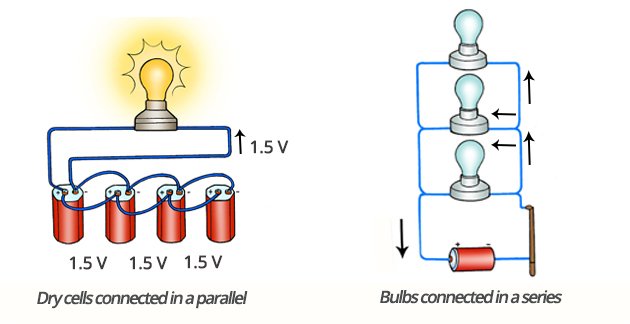
When bulbs are connected in parallel, electric current flows from the dry cell, through the wire, to each bulb, and finally back to the source. Each bulb has its own complete circuit. If there are three bulbs, for instance, there will be three complete circuits. If one bulb is damaged or fails to light up, the other bulb will remain lighted. Each load can be turned on and off without affecting the other loads because it has an independent circuit. Most home appliances such as radios, television sets, flat irons, lighting, fixtures, and computers use parallel circuits.