Basic Concepts on Linear Functions
In chapter 3, you have learned how to graph an equation in the form where A, B, and C are real numbers, and where both A and B are not equal to zero. Recall that its graph is a line, which may be horizontal, vertical, or neither. Any line other than a vertical line can represent the graph of a function. Such a function is called a linear function.
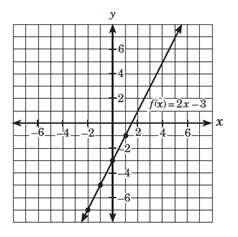
Given the linear function f defined by determine its slope and y-intercept. Graph the given function.
The given function is in the form Thus, it is a linear function with slope and y-intercept A slope of 2 means that there is a 2-unit increase in y for every unit increase in x. A y-intercept of –3 means that the graph of the function intersects the y-axis at Using the technique you learned on graphing functions, construct a table of ordered pairs for
|
Value of x |
Value of |
Ordered Pair or |
| –2 | ||
| –1 | ||
| 0 | ||
| 1 |
The graph of the function is shown in the figure below.