Outer Planets
Neptune
Neptune, which was named after the Roman god of the sea, is the smallest of the gas giants. It is about 49,528 km in diameter and is approximately 4,498 million km away, making it the farthest planet from the sun. It is bluish in color and has six rings around it.
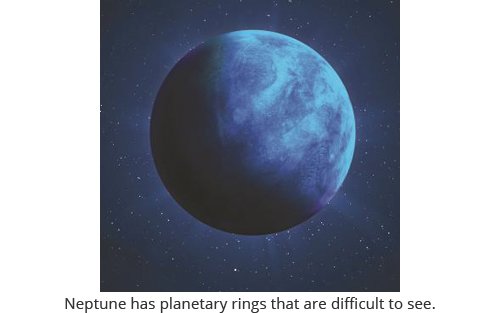
Neptune turns on its axis in around 19 hours and 17 minutes. It takes nearly 60,190 days or 164.8 Earth years to revolve around the sun.
Scientists consider Uranus and Neptune twin planets because both are about the same size. Like Uranus, the atmosphere of Neptune is composed of methane, hydrogen, and ice. Because of Neptune's ice component, Neptune is also regarded as an ice giant.
Neptune has 13 moons. Triton is its most unusual moon because it orbits Neptune in the opposite direction—from east to west.