Investment and Mixture Problems
Glenn, a chemist, would like to make 15 liters (L) of a 20% alcohol solution by mixing the following:
Solution 2: 10% alcohol solution
How many liters of each solution should he use?
Let x be the number of liters of the 60% alcohol solution and y be the number of liters of the 10% alcohol solution.
It will be helpful to organize the given information in a table, as shown below. The illustration after the table will also help you visualize the given problem.
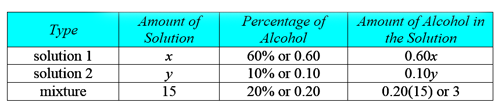
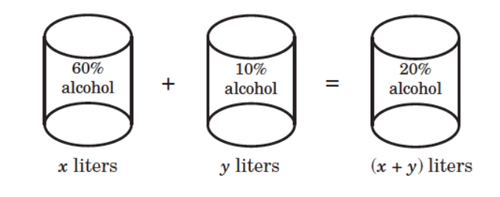
The two equations are obtained as follows.
You now have a system of two linear equations in two variables.
To eliminate x, multiply both sides of the first equation by and then add the result to the second equation.
Solve for y in the resulting equation.
The solution of the system is
With and the total number of liters of the mixture is
The total amount of alcohol in the mixture is
The percentage of alcohol in the mixture is
The conditions of the problem are satisfied. Thus, Glenn should use 3 L of solution 1 (which is a 60% alcohol solution) and 12 L of solution 2 (which is a 10% alcohol solution) to obtain the desired mixture (which is a 20% alcohol solution).
