The Nature of Waves
Look at the two boys in the figure. Observe how they try to make their toy boats reach the other side of the tub without their hands having to touch the boats. Notice how boy 1 moves his hand back and forth on the water near his boat while boy 2 blows air directly on his boat. Which of the boats do you think will move faster? Why?
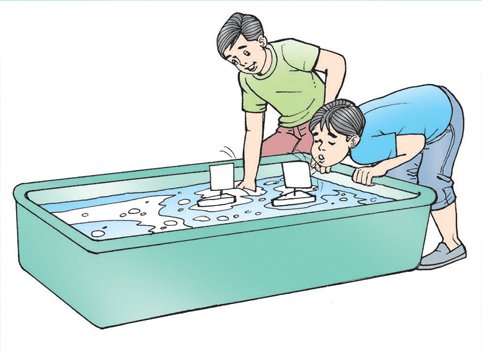
If you guessed that boy 1’s boat reached the other end faster, then you guessed right! This is because his boat moved faster when he made stronger waves on the water with his hand.
Moving the boats from one side of the tub to the other required energy from the boys. By blowing on his boat, boy 2 transferred his energy directly to the boat. By moving his hand back and forth in the water, boy 1 transferred his energy to the water, thus disturbing it and producing waves. The waves carried the energy that boy 1’s boat needed to move forward.
You have seen then how a wave carries energy from one point to another. A single disturbance or wave forms a wave pulse, while a series of disturbances form a wave train.