Classification of Waves
Types of Mechanical Waves
Based on the relative motion of the particles of the medium, mechanical waves are classified into transverse and longitudinal waves.
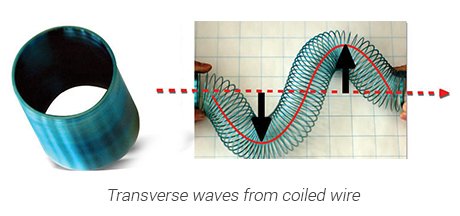
You can replicate these two types of mechanical waves using a piece of coiled wire. If you hold one end of the coiled wire in place and move the other end from side to side, you will generate a transverse wave, or the wave type that moves perpendicular (at 90-degree angle) to the motion of the particles of its medium. A water wave is an example of a transverse wave.
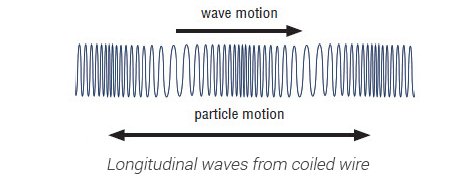
If you hold one end of the coiled wire in place then move its other end toward and away from you, you will produce a longitudinal wave, or the wave type that moves parallel to the motion of the particles of its medium. A sound wave is an example of a longitudinal wave.
A longitudinal wave has a succession of points where particles move close to each other and points where they spread apart. The points where particles move closer are called points of compression, while the points where particles spread out are called points of rarefaction.