Ecological Relationships in an Ecosystem
Symbiosis
Not all organisms that live in the same environment are in a continuous battle for survival. Studies have shown that most species survive because of their “amicable” relationships with other species. One such relationship is symbiosis, in which a close and permanent association exists between organisms of different species.
Mutualism, commensalism, and parasitism are the three main classes of symbiotic relationships.
Mutualism
A mutual relationship is one in which both organisms benefit from the relationship. One example is the relationship between ants, which protect aphids from their predators, and aphids, which supply ants with food. Aphids suck up substances from plant tissues. Ants benefit from the sugary liquid from excess substances that aphids secrete.
Parasitism
With parasitism, an organism lives on or in another organism that is typically bigger. A mosquito is considered a parasite, as it sucks blood from its host, or the organism that the parasite depends on for its food. A parasite that lives outside its host’s body, such as the mosquito, is an ectoparasite while one that lives within the host’s body, such as a hookworm, is an endoparasite. Generally, parasites do not kill their victims though the presence of endoparasites in their hosts’ bodies or a virus transmitted by an ectoparasite can be a cause of death for the hosts.
Commensalism
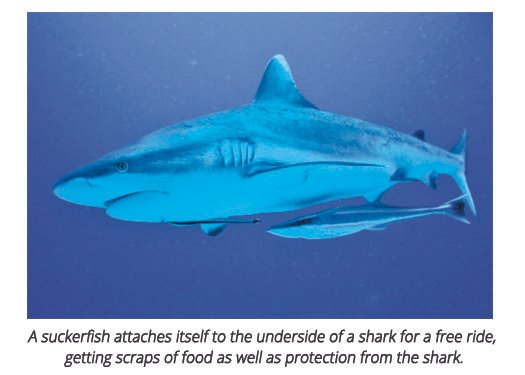
The relationship wherein one organism benefits without harming nor affecting another organism is known as commensalism. An example of this interaction is the relationship between a shark and a suckerfish.
Another example of commensalism is evident between the barnacles (small marine mollusks) that attach themselves to the shells of turtles.