Adjective and Adverb Phrases
Can prepositional phrases be used as adjectives or adverbs? Read through the following sentences and tell what the underlined phrase or group of words is describing in each sentence.
The chickens in the cornfield were scratching the seeds out.The carabaos in the rice paddocks ran with its tail and hooves covered in mud.
A prepositional phrase can be used as an adjective or an adverb. A prepositional phrase used as an adjective describes a noun or pronoun, and is called an adjective phrase. The following underlined phrases in the sentence describe the nouns—chickens and carabaos.
Study the phrases below:
| Noun | Adjective phrase |
|---|---|
| The chickens | in the cornfield |
| The carabaos | in the rice paddocks with its tail and hooves in mud |
Prepositional phrases should also be placed directly after the word it modifies.
| Misplaced: | The chief gave the chicken to my brother with white feathers. |
|---|---|
| Clear: | The chief gave the chicken with white feather to my brother. |
| Misplaced: | Father put around Mother his arms. |
| Clear: | Father put his arms around Mother. |
Study the sentence below and point out the prepositional phrase. What word does the prepositional phrase modify in the sentence?
The farmer stood against the trunk of an old mango tree.
Look at the answers below.
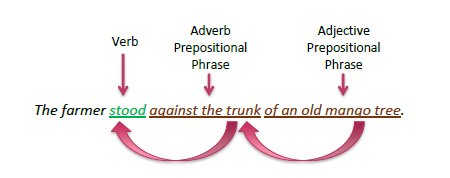
In the sentence, the adverb prepositional phrase against the trunk modifies the verb stood while the adjective prepositional phrase of an old mango tree describes the noun trunk.
What about in this sentence? What word does the prepositional phrase modify?
The sun set quietly over the field.
A prepositional phrase that is used as an adverb describes a verb, an adjective, or another adverb. This is called an adverb phrase.
Like single-word adverbs, adverb phrases answer the questions: how, when, where, to what extent, why, and under what condition.
| Adverb: | He ran lightfooted through his fields. |
|---|---|
| Adverb Phrase: | He ran with light feet through his fields. |
