Energy Pyramid
Not all of the energy in the organisms at one step of a food chain is available to the organisms later in the chain. In general, fewer organisms are found as you go higher in the food chain. A pyramid of numbers shows this clearly. Some organisms may be small but very numerous, so population size may not be a good measure of how much of an organism there is in a habitat. Biomass, or the total mass of organisms in an area, may be a more useful measure.
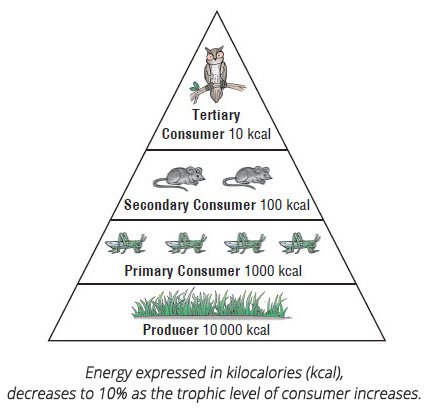
The energy pyramid, also called food pyramid, illustrates the distribution of energy in an ecosystem. It shows that energy is maximized at the producer level, and decreases with increasing consumer levels.
Generally, the amount of energy transferred from one organism to another is reduced to about 10%. For instance, when a herbivore consumes grass with 100% energy, the herbivore only acquires 10% energy, and the carnivores that feed on the herbivore receive no more than 1% of the original energy content. This can be explained by the fact that organisms use some of the energy to maintain life processes, while releasing some energy into the environment as heat. The energy pyramid further suggests that due to the minimal amount of energy received, only few carnivores are sustained in a food web.