Basic Components of an Ecosystem
Biotic Components
Decomposers
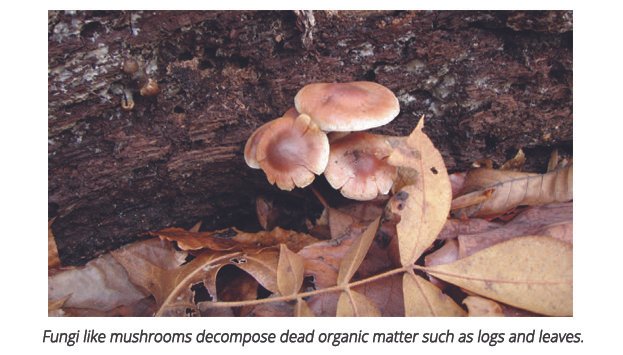
Decomposers, also called saprotrophs, are microorganisms that cause plants and animals to decay and release substances that are reused by green plants or producers. Many inorganic compounds needed by producers may not be readily available if there were no decomposers. Examples of decomposers are bacteria, fungi, slugs, and worms.
Abiotic Components
Ecosystems do not only involve interactions among living organisms. They also constitute the nonliving or abiotic components that influence these interactions. They include the physical factors of the environment, such as soil, light, temperature, air, and water. For instance, producers like plants and other chlorophyll-bearing organisms need solar energy to make their own food through the process called photosynthesis. They also need nutrients that are found in soil, elements from the air such as carbon dioxide and nitrogen, as well as water to enable them to efficiently carry out this process.
Animals and non-chlorophyll-bearing organisms are also influenced by abiotic factors. For one, the oxygen generated by photosynthetic organisms is a vital part of the life-support systems for consumers. Other abiotic factors such as soil, rocks, and minerals depend on water, the universal solvent, for them to be used by living things.